
We define how AI should reshape software engineering, what needs to change, and which initiatives should come first—giving you a practical roadmap from today's delivery model to an AI-native Software Factory.
Engineering teams are already using copilots, coding assistants, agents, and automation across the SDLC. But most adoption happens inside individual activities rather than across the delivery system. The result is faster local execution without the same improvement in end-to-end delivery. Bottlenecks remain between product, architecture, development, testing, DevOps, and release, while organizations keep adding AI tools without a clear model for how software engineering should operate differently.
The goal is not to add AI to every engineering task. It is to redesign how software moves through the SDLC so AI can execute more work while people retain direction, judgment, validation, and control where they add the most value.
We are independent of any single AI model, IDE, platform, cloud provider, agent framework, or development tool. Our perspective combines software engineering, solution architecture, AI automation, testing, DevOps, process engineering, and SDLC transformation. That allows us to design the future delivery system around your engineering reality rather than around the capabilities of a particular tool.
AI Software Engineering Strategy defines the target state and transformation path. AI-Powered Software Factory Transformation is the implementation step for organizations ready to redesign and operationalize that model.
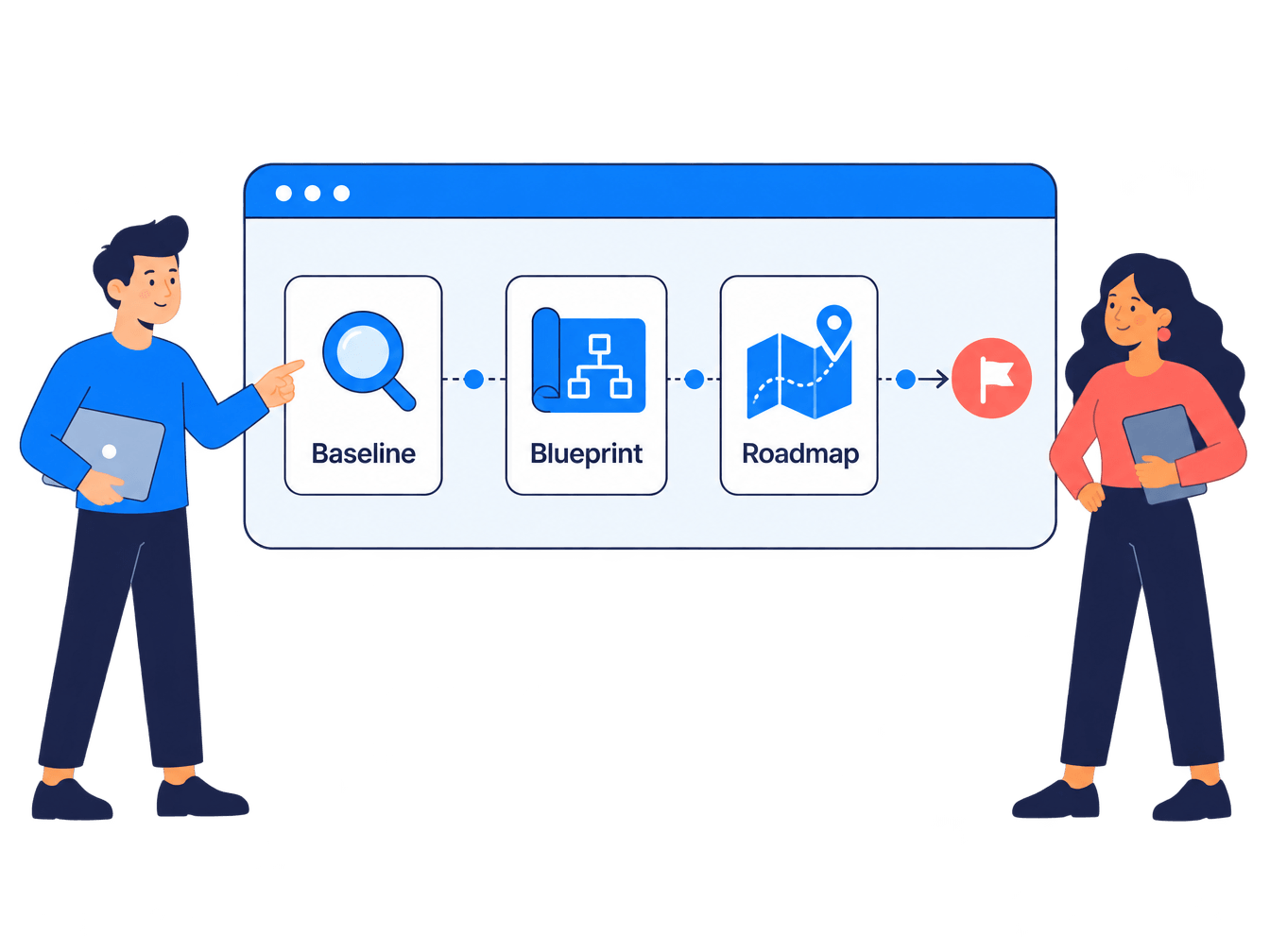
The engagement gives leadership and engineering teams a shared view of where software delivery stands today, how it should operate with AI, and how to move from one state to the other.
A current-state view of how software moves from demand or product intent to production, including major lifecycle activities, roles, handoffs, systems, engineering knowledge, automation maturity, validation, and delivery constraints.
A target operating model showing how the major SDLC domains should work with AI, where different levels of AI execution belong, and where human direction, judgment, approvals, and release control remain necessary.
A readiness and gap assessment combined with prioritized transformation initiatives, dependencies, sequencing, and a practical roadmap for moving toward the target AI-native delivery model.
We assess software delivery across product, requirements, UX, architecture, development, testing, platform, DevOps, deployment, and the relationships between them.
The strategy starts with how software is actually delivered today, so the target model reflects real processes, systems, constraints, and engineering maturity.
We distinguish where AI assistance is enough, where supervised automation creates more value, and where bounded autonomous execution may become practical.
Processes, knowledge, artifacts, systems, integrations, validation, and governance are assessed as requirements for reliable AI execution—not treated as implementation details to solve later.
The target model explicitly defines where people retain direction, expert judgment, approvals, exception handling, acceptance, and release authority.
Initiatives are prioritized by delivery value, readiness, reuse potential, dependencies, effort, and risk rather than by which AI use case is easiest to launch.
Identify lifecycle changes that can reduce delays, handoff friction, repetitive work, and unnecessary coordination across software delivery.
Focus AI investment on changes that reduce engineering effort and improve system-level delivery efficiency rather than adding disconnected tools.
Create a path toward greater delivery capacity through reusable AI-enabled workflows and progressively deeper automation.
Give leadership a framework for deciding which AI initiatives matter, which foundations they depend on, and which experiments should not be prioritized.
Design validation, engineering standards, and human control into the future delivery model rather than relying on additional review after AI output is produced.
Move toward reusable processes, knowledge, systems, and automation that can support multiple teams and products instead of isolated use cases.
Give engineering and leadership teams a shared view of what should change first, what depends on it, and what can follow later.
Increase AI execution as processes, knowledge, integrations, validation, and governance become ready—without giving up engineering control prematurely.
We will review how your software delivery system works today, how AI is already being used, where the biggest lifecycle constraints remain, and what would need to change before deeper AI execution can scale.